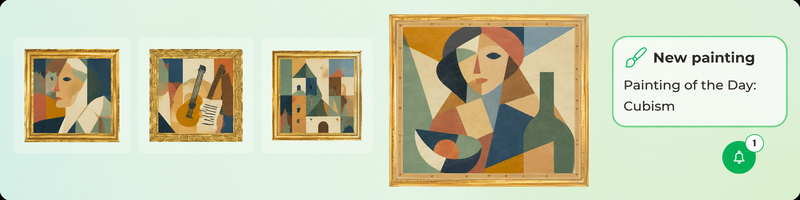
Discover the fractured forms, multiple perspectives, and bold ideas of Cubism, one remarkable painting at a time.
Each lesson introduces one painting, explores how its subject has been transformed, reveals the ideas and history behind it, highlights important visual details, and explains why the work matters.
Sample full lesson from this feed:
----------------------------------------------
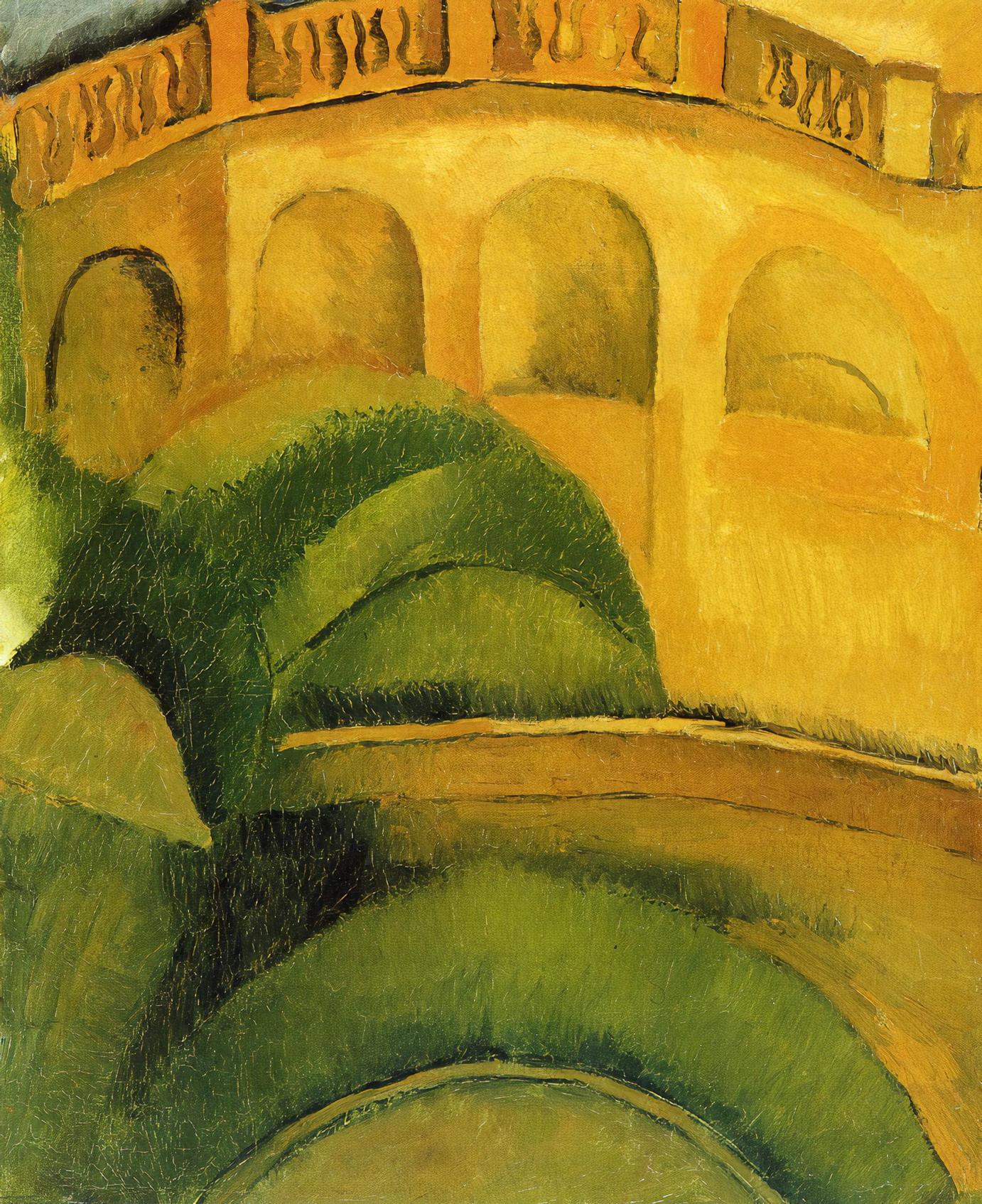
Arcades at L'Estaque, 1908
The Lesson
Before Raoul Dufy became known for his breezy, brightly colored scenes of the French Riviera, he passed through a brief, intense period of structural experimentation. Arcades at L'Estaque (1908) asks us to look past the details of nature and focus instead on its underlying geometry.
The Story It Tells
This is a landscape stripped of the ephemeral. Dufy does not paint individual fluttering leaves or a passing breeze. Instead, he paints the heavy, solid mass of the trees, turning them into sweeping, geometric curves that dominate the foreground. These swelling green forms are in direct conversation with the rhythmic, architectural curves of the yellow arcades behind them. The entire composition is an exercise in rhyming shapes and interlocking volumes.
The History It Hides
The year 1908 was a monumental one for modern art, and the town of L'Estaque in southern France was its laboratory. Following a massive retrospective of Paul Cézanne's work in 1907, Dufy and his contemporary Georges Braque traveled to L'Estaque. They were heavily inspired by Cézanne's advice to treat nature through basic geometric forms—the cylinder, the sphere, and the cone. In this painting, we see Dufy doing exactly that, participating in the early proto-Cubist experiments that would forever change how painters depicted reality.
Look Closer
The palette: Notice the stark reduction of color. Moving away from his earlier, wild Fauvist colors, Dufy restricts himself to a disciplined, earthy palette of ochres, yellows, and deep greens.
The repeating curves: Trace the line of the arches in the background, and watch how that exact semi-circular energy is mirrored in the green foliage below.
The compressed space: The background and foreground seem to push against each other, flattening the space and reminding the viewer that they are looking at a two-dimensional painted canvas, not a window into the world.
Why It Matters
This painting is a perfect snapshot of a transition. It captures the moment when European painting pivoted away from capturing fleeting light and vibrant emotion, and turned instead toward the intellectual breakdown of structure, mass, and form.
----------------------------------------------
Follow this feed now to discover and understand one remarkable Cubist painting every day!
Similar feeds are available for Abstract Art, Art Nouveau, Baroque, Color Field Painting, Expressionism and Fauvism, Impressionism and Post-Impressionism, Minimalism, Pop Art, Realism, Renaissance, Romanticism and Symbolism.